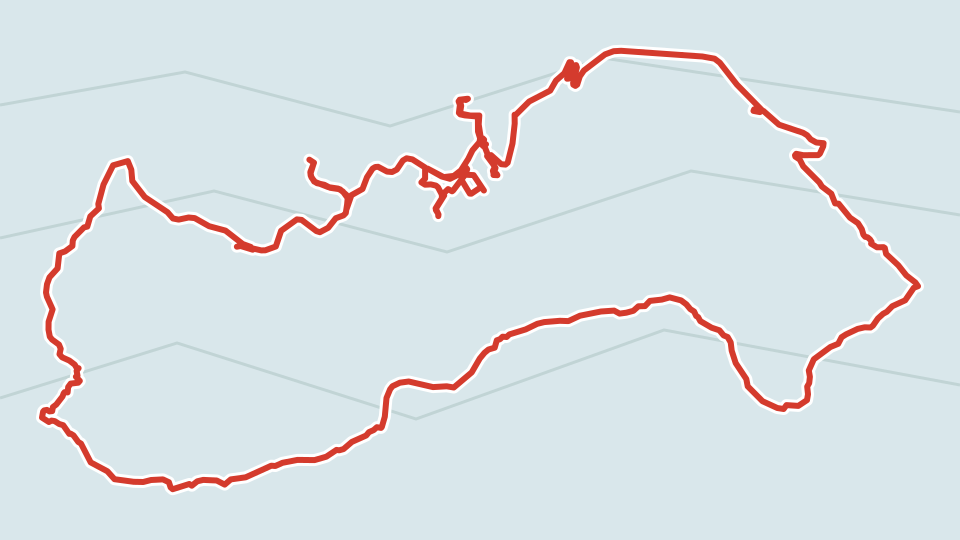
When I was planning my trip, I wanted to do a loop, hitting the towns of Yeruham and Dimona, and taking a train back from the latter. Life, however, is a bubbling, boiling thing that changes plans, and my previous trips had taught me a little to adapt on the fly. I agreed with Nathan that I would head back to him on the first bus on Saturday evening, and with Igal – that I'd crash in his hospitable hangar for one more night. That's how the night from Friday to Saturday went. Jumping up at seven in the morning, I discovered Igal in the living room cuddling with an oriental beauty, both sleeping next to a pile of empty wine bottles. Igal politely inquired if they had kept me awake, which confirmed that the hot moans at three in the morning weren't just my imagination. The girl bashfully covered herself with a blanket, to which I flashed an encouraging smile, and stomped off to the kitchen - to cook some porridge.
The last day in the Negev desert had arrived. This time I rolled out in the other direction, and was warned: “rough descent, be careful”.

Now that's an apple

Part of the town

An old man cruising on an electric cart

The observation point overlooking the great void is properly equipped

Today the crater isn't as hazy

A mating ritual, naturally
And so relationships lose their former shine and gloss, get covered in rust and jam up, and there's no pulling them apart the normal way anymore – only with a saw or a hammer, when dust or shards go flying everywhere, and there's no way to fix anything. The moral of the story is: you gotta lubricate and cover up against the bad weather, that way you can easily stretch out a good decade or two.

Yesterday I showed you the exact same thing from the other side, the northern one

High-tech even at provincial bus stops

And right next to it — low-tech

On the horizon — a camel observation post

How could I not climb it, seeing it right there

One of the camels looks quite suspicious

The whole little town

In the other direction, there are only the communication towers of the research center

Suddenly, a sign!

With asphalt like this it'd be a sin not to drop by, whatever might be waiting for me at the end

For 5 euros they'll pour you some tea, chatter about alpacas, and hand you a little bag of feed
I decided to shake off superpower-centrism and move towards Eurocentrism, so from now on and forever I will give the prices in this blog in euros, especially since it's now my native hard currency.

On the right — the owner and a hired worker, on the left — a volunteer from Canada. We got to chatting, and it turned out she's a couchsurfer, a smart cookie, a beauty and a Komsomol member, knows around 5 languages and at a relatively young age has already traveled half the world.

Here it is, an alpaca, finally
Who exactly are alpacas? Camelids, but not your regular kind, rather from the high-altitude Latin Andes. You probably know about llamas (not the enlightened ones, but the ones still on the lower, animal evolutionary rung). Well, alpacas are their relatives, but not direct ones, as was previously believed. They live at an altitude of over 3500 meters, their wool is long, but their temper, on the contrary, is meek. The animals are inquisitive and peaceful, the absolute maximum you're risking is getting spat at, and even that is accidental, not malicious like with classic camels. Alpaca wool is so good that it cures AIDS doesn't get dirty, doesn't let water through, and is seven times warmer than sheep's wool.
No wonder that, inspired by such marketing spiels from the South American Indians, some enthusiasts decided to charter a whole plane to drop a herd of fifty heads from Latin America into Israel. Back in the sixties, they still had enough money to rent a plane (it's scary to imagine how much that would take now), but, fortunately, not enough bureaucrats on both sides to forbid it. They settled the alpacas in the Negev so they could enjoy the local winter, otherwise the wool won't grow. The critters aren't slaughtered for meat, they just carefully shear pure cash right off them — because, as already mentioned, alpaca hair is eco-friendly and comfortable to the max, and the number of visitors to the farm has surpassed a million.

The main storyteller

An obedient beast

So much so that you can scoop it up and stuff it into a quad bike

We tie the second one in the back — and off we roll

Life on the farm flows unhurriedly

“We even have a pig,” the guide proudly informed me

It's scary to approach the older brother, but the younger one is a total cutie

The famous crazy stare
I liked it at the alpaca farm, even though I dropped by accidentally. In general, the stars just aligned that way; it was Mike's wife, Yael, who first mentioned the farm to me, but he himself joked that alpacas aren't local, and it's basically a way to dupe tourists, showing them just anything entertaining instead of something less amusing but more educational. Like Mike's other thoughts, this makes total sense to me and resonates well. Yes, you have to maintain a balance between entertainment and business, between fun toys for amusement and learning about the world, between rest and work, between anima and animus, between spontaneity and planning. My friend Dima understood things about balance, and I felt balance in Mike's words. I myself am devoid of it, and so, forever thrashing from side to side, stumbling, approaching the edge of the abyss, and climbing up mountains, I am eternally doomed to push the bicycle of my life forward, because if I stop it, it will vanish like the morning haze over Makhtesh Ramon. As long as it's in motion, you can see its outlines, its structure, and its swiftness, but if you slow down, you realize it's just a mirage, and you'll soon be left sitting bare-assed on sharp rocks.